

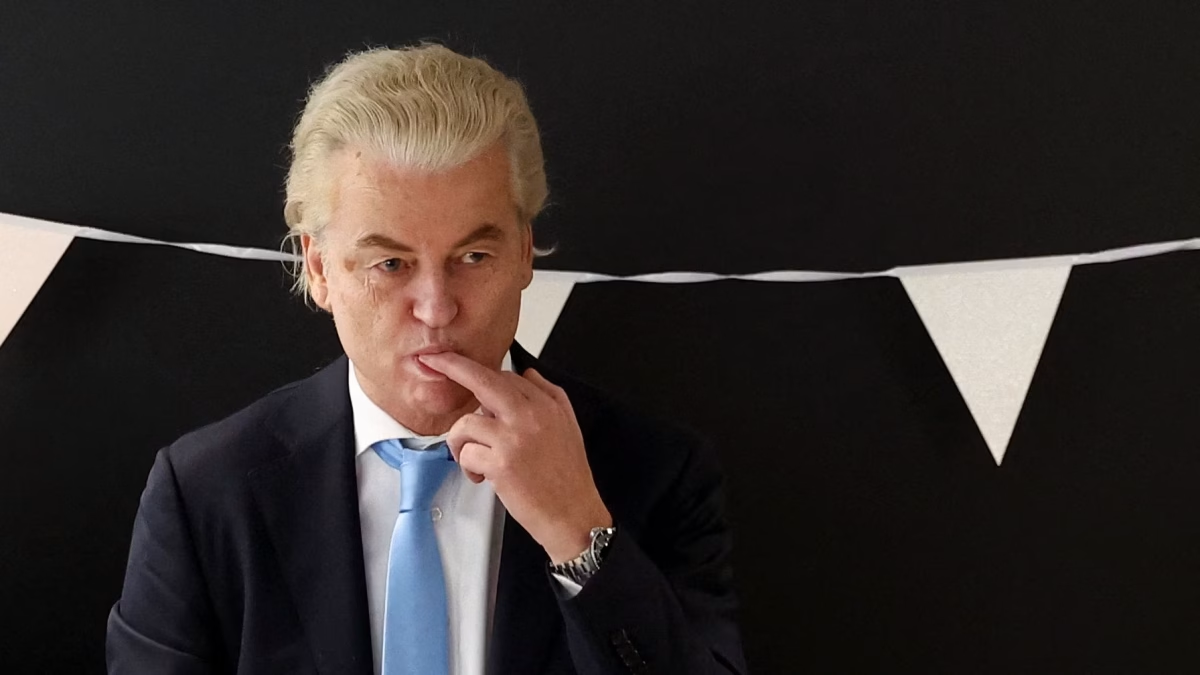
(Photo via Heute/CC BY 4.0 DEED)
On August 4, 2025, Dutch politician Geert Wilders posted an image on X that caused outrage. The Netherlands will be holding elections this fall, and as head of the largest political party in the Netherlands, the extreme right-wing Party for Freedom (PVV), Wilders asked voters: “Who would you prefer to have in charge?”
On one side, we see a blond-haired, blue-eyed woman with a kind smile. On the other side, an angry-looking woman in a hijab. Beneath the faces, the image lists two faces. The image insinuates that voting for PVV means voting for friendly white people, and voting for the left-wing Labour Party (PvdA)—the second largest in the country—means voting for dangerous immigrants.
Shortly after Wilders posted the image, outraged citizens drew parallels between the post and Nazi propaganda from the 1930s, with this “So oder So?” pamphlet being the most striking. Within a week, Discriminatie.nl—a national hotline against hate speech and discrimination—reported 9,000 complaints of discrimination as a direct result of Wilders’ post.
Various Islamic organizations have filed charges against Wilders. According to them, he is intentionally using this type of imagery to strengthen the us-them rhetoric in the Netherlands to fuel hate against immigrants and galvanize support for his party. This political strategy is widely used to normalize violence and discrimination against minorities, and the Nazi’s famously implemented it to mould German society into allowing and supporting the genocidal atrocities they committed during WW2.
Genocide Watch is an organization that revolves around the prediction and prevention of genocides. It analyzes countries around the world using the “Ten Stages to Genocide” model to ascertain what danger there is of slipping into genocide, and what measures states need to take to prevent this from happening.
The organization publishes reports on countries it considers to be of relevance. The Netherlands is not listed, insinuating that there is no danger there. However, in an environment where the head of the most influential political party can post blatantly racist images as a way to gather support, it may be wise not to assume that the country is as welcoming and pluralistic as it appears to be. The Ten Steps to Genocide
The Ten Steps to Genocide is a theoretical framework devised by Dr. Gregory Stanton used to analyze the amount of persecution minorities face in a given country. It stems from the assumption that, regardless of the unique political and cultural factors each state faces, the path to genocide always follows the same ten steps. This is important because it shows that any country can perpetrate genocide if these steps are taken, and it also makes it easier to prevent genocide from happening before it is too late.
The ten steps are:
- Classification: when the dominant group — in most cases the state — use markers to place the targeted group into a different category than the majority. These markers can be religion, ethnicity, race, or—most importantly in the current nation-state system—nationality.
- Symbolization: The different groups have outward symbols or names that the dominant group use to further strengthen the us-them mentality. In contemporary politics, we may refer to people of a certain ethnicity as Gypsies or Muslims, and use these markers to define a person’s identity, regardless of whether this is representative of the beliefs they hold.
- Discrimination: The next step involves using these classifications and symbols to limit a person’s access to services and deprive them of their rights. The dominant group uses these groups to give itself more power over the minority group, and enshrines these differences into law.
- Dehumanization: This step consists of reducing people of the minority group to something less than human. The dominant group uses propaganda to vilify them and to indoctrinate society into believing this. To do so, they use hate speech.
- Organization: For genocide to take place, the state must either organize the killings itself or support militias who will do it for them. Often, the latter is chosen so that it is easier for them to deny responsibility.
- Polarization: Leaders from the dominant group purposely divide society to facilitate the genocide. Contact between the dominant group and minority group is limited or prohibited. Moderates are arrested or killed, and the dominant group squashes any sign of protest.
- Preparation: By framing the minority group as a ‘problem’, the dominant group is able to offer a ‘final solution’. They tend to refer to the minority group as a disease or threat that they must free themselves from. It is often framed as an ‘us or them’ question, cloaking the act of genocide under claims of self -defense.
- Persecution: Members of the targeted group are now separated and killed, tortured or forcibly displaced. The purpose of these acts is to destroy the group. This can be done in many ways, but the intent is the same.
- Extermination: At this point, the sole aim is to rid the state of all members of this group. The killings are called exterminations because the dominant group does not see the targeted people as human. They also perform exterminations through mass rapes, aimed at genetically altering the victim group. The violence is done in a ruthless, totalitarian manner.
- Denial: This is done throughout the process and always follows the atrocities. The perpetrators cover up the killings, they intimidate the witnesses, and an alternate story is invented to push the blame onto someone else—usually the targeted group.
As we see here, these steps show the slippery slope to inexcusable violence. They echo the plight of Bosnian Muslims in Srebrenica, women in Darfur, Palestinians in Gaza, and many other tragic stories.
The resulting horror may seem out of reach to many liberal democracies, but seeing the step-by-step process shows that it is within us all to commit these atrocities, and that it is our responsibility to continuously reflect and hold ourselves accountable if we want to prevent them.
Islamophobia in the Netherlands
Like in much of the rest of the world, Islamophobia as we know it became a prominent problem in the Netherlands after 9/11. The hostile attitudes caused by the terrorist attack, coupled with increased migration from the Middle East/North Africa (MENA) region to Europe in the last decade, have led to a marked increase in Islamophobic incidents in Europe.
In 2006, Geert Wilders registered a new political party: the PVV. It was, and remains, a one-man party – he is the only registered member – and revolves around combatting the “Islamisation” of the country and reducing the number of refugees allowed to enter.
Until recently, the PVV was a popular, but still reasonably fringe, party. It never had much of a chance of joining a ruling coalition, and stayed firmly in the opposition. However, islamophobia and nativism have increased enormously in recent years.
The Netherlands is now more Islamophobic than the rest of the EU. In 2022, 47% of Muslims in the EU had experienced islamophobic violence (verbal or physical), up from 39% in 2016. In contrast, the same poll showed that 55% of Muslims in the Netherlands have faced this type of harassment. The EU average for child Islamophobic bullying is 8%; in the Netherlands, it is 15%.
In 2023, the Dutch national parliamentary elections reflected these attitudes as the PVV became the largest political party in the Netherlands. After some difficulty, Wilders managed to form a right-wing coalition under the leadership of Prime Minister Dick Schoof. This coalition lasted less than a year before failing, with new elections planned for next October. However, in that year, discriminatory and dehumanizing language and policies were common, and Wilders’ recent post on X shows that he has no plans to slow down.
A Slippery Slope For the Netherlands
Genocide Watch has not yet released an assessment of the Netherlands. However, based on the Ten Steps to Genocide framework and an analysis of the events of the past year, we can see that the Netherlands are treading a dangerous path.
The coalition agreement that was presented in 2024, after formation, lays the groundwork for the discriminatory events that followed. According to the document, being a Dutch citizen comes down to “participating and having Dutch values”. The approach for integration, according to this coalition, involves “regulating calls to prayer” and “removing undesirable influences, such as weekend schools.”
It is clear from this agreement that people who make use of calls to prayer or who attend weekend schools—such as Koranschools—are not considered true Dutch citizens. If we look at the definitions of the steps to genocide, this classifies Muslims as ‘other’ and ‘not Dutch,’ thereby enabling future discrimination.
Normalization of Hate and Dehumanization
Throughout their time in power, the coalition also normalized hate speech. After the events of November 7th—when Dutch Arabs and Israeli hooligans came to blows—the Dutch government weaponized this tragedy against their Arab and North African communities. The Minister of Migration and Asylum, Marjolein Faber, stated that she believes that “antisemitism lives in the genes of Moroccans.” At the same time, Geert Wilders himself described the events as “Muslims with Palestinian flags hunting Jews.” These statements reduce all practitioners of Islam, and – as Marjolein Faber stated – all people of Moroccan descent, into two-dimensional, violent people, which is far from true.
This hateful and dehumanizing language is being used by the most influential politicians in the country, normalizing intolerance of Muslims throughout Dutch society. As we see in the ‘Steps to Genocide’ framework, the widespread use of hate speech contributes to the dehumanization of the targeted group, enabling violence in the future. The Dutch government’s aggressive attitude was so hostile that Nora Achahbar, a member of NSC, the most centrist party in the coalition, felt so unsafe that she resigned.
Turning Migration Into A “Crisis”
The coalition also proudly passed “the strictest migration regime ever.” Their goal was to surpass all other EU member-states on this front. To achieve this, they passed an “asylum crisis law” that considers the situation a state of emergency. This is despite the Netherlands receiving less than the EU average number of asylum seekers per capita, and being in the top five richest countries in the EU.
This state of emergency is aimed at limiting the number of migrants entering the country, most of whom are of Syrian origin. It allows the government to bypass some of the protections offered to asylum seekers, making it more difficult for them to receive refugee status, and easier to deport those who do not meet the criteria.
This framing of migrants – many of whom are Muslim – as a “crisis,” and treating them as such, is, in any case, discriminatory, and could even be considered an act of preparation, which would place the Netherlands at step 7 on the path to genocide. In the preparation stage, the dominant power frames the targeted group as a crisis that must be dealt with at any cost. As we can see, the discourse around migration in the Netherlands echoes these sentiments.
During his time in power, Wilders also tried to pass multiple anti-Islam laws, but ultimately withdrew them due to a lack of support from the other parties. These included: prison time for visiting a mosque; removing double nationality for public servants; and preventative detention for suspected jihadists.
Other laws he has not formally proposed yet include giving Dutch citizens first pick of housing, a burqa ban, and the removal of the law against group insult. The last one is particularly attractive to Wilders because the Dutch courts charged him with this offence after leading a chant for “Less, Less Morroccans!” at an election campaign. These proposed and planned policies are discriminatory and dehumanizing.
A Warning Sign
It may appear as if the story has a happy ending, due to the coalition failing. However, polls show that the PVV is the frontrunner at the next elections. This means that, regardless of the success and failure of the past coalition, a very large proportion of Dutch society agrees with the way the PVV—with Wilders at its head—has acted, and that they would like to give them the opportunity to continue.
If we want to protect human rights and keep plurality—religious, ethnic, racial or otherwise—a cornerstone of our liberal democracies, we cannot allow this type of politics to run amok. Even if genocide is not a likely end result of Wilders in power, accepting step 4, the dehumanization of a minority, risks unravelling the fabric our societies are made up of. And once we accept the mistreatment of others based on arbitrary classifications, there is very little preventing this from turning into violence.
Edited by Gustavo Villela


